A pivotal stage has been reached in Turkey’s MİLGEM project for Indonesia, marking one of Ankara’s most significant defense industry export initiatives in the Southeast Asian market. Official sources confirm that the formal process for the construction of two İSTİF-class frigates, destined for the Indonesian Naval Forces, has officially commenced.
Following the memorandums of understanding previously signed between Turkey, Qatar, and Indonesia, the Turkish consortium TAİS has now executed the definitive contract for the export of these two advanced frigates. The ambitious project is notably underpinned by crucial credit financing provided by Qatar, effectively operationalizing this substantial trilateral defense industrial collaboration. This innovative export financing model is central to the strategic depth achieved by the “Turkish-Qatari-Indonesian Defense Industry Cooperation.”
Turkish shipyards are currently experiencing an unprecedented level of activity, with approximately 50 military vessels under simultaneous construction, including seven İSTİF-class frigates. The lead ship of the class, TCG İSTANBUL (F-515), has been actively serving within the Turkish Naval Forces for an extended period.
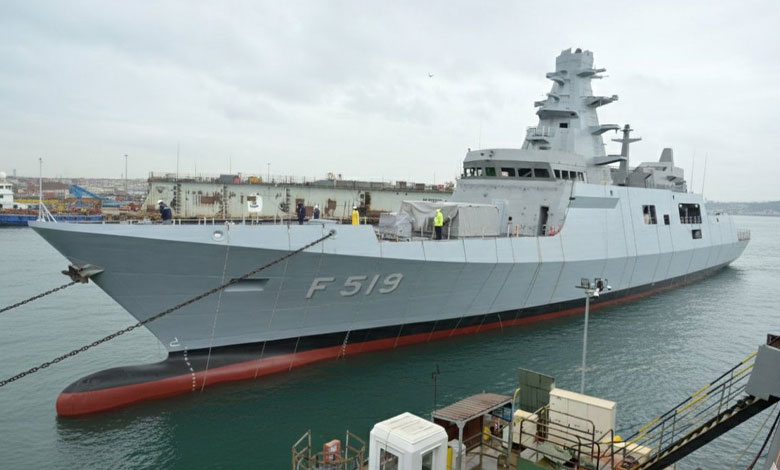
Earlier speculation within defense circles suggested that frigates with pennant numbers F-516 and F-517, currently undergoing construction, would be allocated for Indonesia. However, proprietary intelligence obtained by SavunmaSanayiST.com indicates a revision to this plan. Due to the Turkish Naval Forces’ escalating operational demands, the delivery schedule has been adjusted. Under the new arrangement, frigates F-516 (TCG İZMİR), F-517 (TCG İZMİT), and F-518 (TCG İÇEL), which are in the final stages of construction and testing, will be directly integrated into the Turkish Navy’s inventory. Indonesia is now slated to receive frigates F-519 and F-521, with deliveries anticipated between 2027 and 2028. The remaining vessels of the class, F-520 and F-522, will also enhance the operational capabilities of the Turkish Navy.
To mitigate any potential gap in the Turkish Naval Forces’ combat strength due to the export, construction of new frigates to replace F-519 and F-521 will be expedited. Furthermore, a significant portion of the revenue generated from this export contract will be reinvested to finance the development and construction of next-generation warships for the Turkish Navy, demonstrating a self-sustaining defense procurement model.
This Qatar-financed project represents a landmark achievement for the Turkish defense industry. It marks Turkey’s inaugural export of a frigate-scale major surface combatant to an Asia-Pacific nation. Preceding this, ASFAT had facilitated the export of four MİLGEM ADA-class Corvettes to Pakistan, while STM had delivered three such corvettes to Malaysia.
Beyond the platform export, the contract encompasses a comprehensive integration of indigenous Turkish defense technologies. This includes advanced sensor and electronic warfare systems from ASELSAN, national missile systems developed by ROKETSAN, naval gun and weapon systems manufactured by MKE, and sophisticated command and control systems from HAVELSAN.
Through this innovative export strategy, Turkey is cultivating a financially self-sustaining and robust ecosystem for military shipbuilding. This model holds the potential to evolve further, possibly positioning Turkey as a “Regional HUB” for the maintenance and overhaul of foreign naval vessels.
The İSTİF-class frigates, representing the second phase of the original MİLGEM ADA-class Corvette concept, are Turkey’s first national frigate design, conceived and developed entirely through domestic capabilities. Optimized design parameters endow them with superior seakeeping characteristics and an extended operational range compared to their ADA-class predecessors. With a displacement of 3150 tons and a length of 113 meters, these frigates can achieve a maximum speed exceeding 29 knots.
Equipped with the ASELSAN CENK-S AESA radar, the İSTİF-class boasts extended-range, high-precision detection and tracking capabilities for aerial threats. The vessel integrates Turkey’s pioneering national vertical launching system, ROKETSAN MİDLAS, enabling the deployment of HİSAR-D air defense missiles. For potent anti-surface warfare capabilities, the formidable ROKETSAN ATMACA anti-ship missile is integrated, making the İSTİF class a fully independent strike platform. The initial four ships of the class were constructed under the lead of STM. The platform is further outfitted with indigenous sonar systems and torpedo tubes, ensuring high survivability against subsurface threats.
Disclaimer: This content has been aggregated and reported by our automated systems.


admin