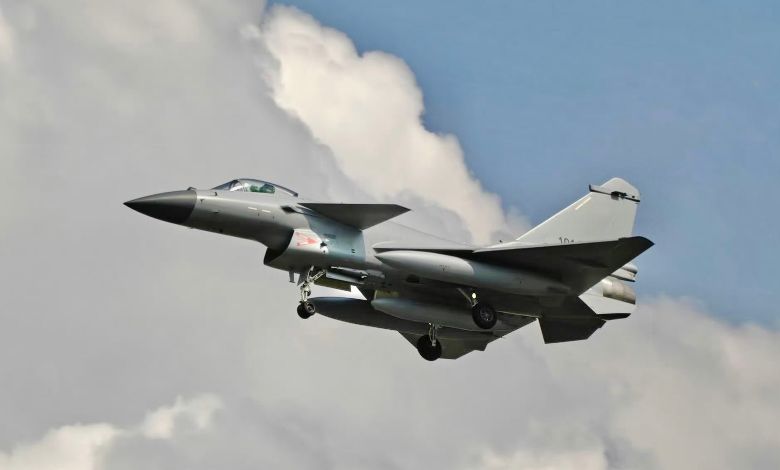
Tashkent has officially confirmed the integration of Chinese-built Chengdu J-10CE multi-role fighter aircraft into the Uzbekistan Air Force, with state television broadcasting footage showcasing the new jets. The public reveal occurred as part of the nation’s 35th independence anniversary celebrations, putting an end to over a year of speculation regarding the procurement.
The televised segment featured at least six J-10CE fighter jets, emblazoned with Uzbek national markings, performing formation flights and executing landings at an airbase. Notably, one aircraft was filmed deploying its drogue parachute, which bore the Uzbek flag, during its final approach. This imagery serves as the first definitive visual evidence of the J-10CEs in Uzbek service.
While the Uzbek government has yet to release comprehensive details concerning the total number of aircraft acquired, the overall contract value, or the delivery timeline, the visible jets are presumed to represent an initial tranche of the order. Prior unconfirmed reports suggested Uzbekistan might acquire up to 24 J-10CEs in a deal valued around $1 billion, but these figures remain officially unverified by either Tashkent or Beijing. Although some reports indicate the aircraft are based at Karshi-Khanabad Air Base in southern Uzbekistan, this information has not been corroborated by Uzbek authorities.
Insights from the footage reveal specific technical configurations. Two of the aircraft were observed carrying three external fuel tanks – two under the wings and one centerline under the fuselage – indicating a ferry configuration. The jets are believed to have undertaken an approximately 3,000-kilometer flight from Chengdu Aircraft Corporation’s (CAC) manufacturing facilities in Chengdu, China, to Uzbekistan; details regarding potential en-route refueling stops remain undisclosed. Interestingly, the J-10CEs delivered to Uzbekistan appear to lack the fixed in-flight refueling probe typically located on the forward right fuselage of the J-10 series, a modification that may suggest specific operational roles or a different refueling strategy for the Uzbek fleet.
Uzbekistan’s acquisition marks it as only the second international operator of the J-10CE, following Pakistan. This move signifies a strategic pivot in the modernization efforts of the Uzbek Air Force, which has historically relied on Soviet-era platforms such as the MiG-29 and Su-25. The integration of the J-10CE underscores a clear shift towards advanced Chinese aviation technology to rejuvenate its combat fleet.
The J-10CE is the export variant of China’s domestically developed J-10C, a single-engine, fourth-generation multi-role fighter. It boasts a sophisticated active electronically scanned array (AESA) radar and an advanced avionics suite, enabling it to conduct a wide array of missions including air superiority, ground attack, and precision strike operations. Its combat capabilities are augmented by a diverse arsenal of air-to-air missiles, including the infrared-guided PL-10 for close-quarters combat, the medium-range PL-12, and the active radar-guided PL-15E designed for beyond-visual-range engagements.

admin