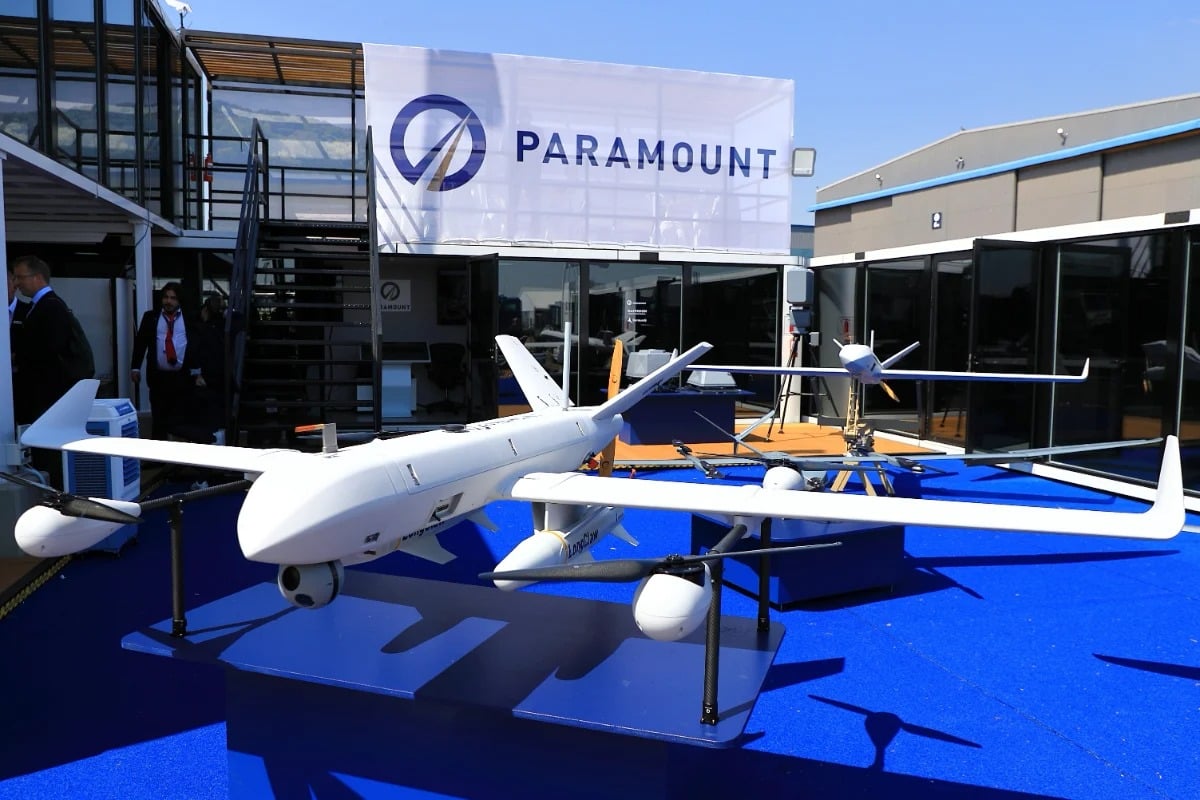
South African defense prime Paramount has introduced its latest innovation, the V-Raven Vertical Take-off and Landing (VTOL) Unmanned Aerial Vehicle (UAV), at the Africa Aerospace and Defence (AAD) exhibition. This new, reusable platform represents a significant leap forward from previous designs that relied on catapult launch systems, offering unparalleled operational flexibility.
Sello Ntshiele, a senior executive at Paramount, emphasized that the V-Raven was developed with the demanding realities of modern African operational environments in mind. He highlighted the critical need for defense forces to achieve extended observational ranges and prolonged on-station presence, citing challenges such as vast operational areas, rugged and remote terrains, dispersed threats, and the increasing proliferation of unmanned systems. According to Ntshiele, the V-Raven consolidates these vital capabilities into a highly adaptable and reusable unmanned aerial asset.
Ntshiele further explained that the V-Raven presented at AAD marks the next phase in its development lifecycle. Built upon a common air vehicle architecture, the system can be tailored for various mission profiles to meet specific operational demands. While the initial focus is on delivering a high-capability Intelligence, Surveillance, and Reconnaissance (ISR) platform, this flexible architecture also supports the future development of different mission configurations, including light attack capabilities.
The V-Raven evolves from Paramount’s N-Raven program, initially showcased in 2021, which featured a swarming capability. The N-Raven was a catapult-launched system weighing 41 kilograms, with a cruise speed of approximately 180 km/h and an endurance of around two hours. The V-Raven distinguishes itself by integrating VTOL functionality, thereby eliminating the reliance on runways or extensive launch infrastructure. Paramount asserts that this feature enables forces to deploy and recover the UAV from remote, decentralized locations without requiring fixed ground support.
The V-Raven is offered with two distinct propulsion system options. The gasoline-powered variant boasts an extended endurance of up to eight hours and an impressive operational range of 1,200 kilometers, cruising at roughly 140 km/h. Its communication link with the ground control station extends up to 150 kilometers. Conversely, the electric version, while more compact, sacrifices some range and endurance, offering up to two hours of flight time and a maximum range of 250 kilometers. Despite the propulsion differences, both configurations share a common airframe, featuring a 3.6-meter wingspan, a 2.1-meter fuselage length, and a maximum take-off weight (MTOW) of 65 kilograms.
Paramount showcased the V-Raven’s utility by citing security challenges prevalent in regions such as the Sahel and northern Mozambique. In these expansive and challenging environments, where settlements and operational zones are often widely dispersed, operating UAVs from traditional airbases proves impractical. The lack of runways or permanent airbases, especially in remote areas with limited fixed infrastructure, creates a significant operational imperative for easily deployable and recoverable unmanned systems. The V-Raven’s VTOL capability directly addresses this, allowing operations from smaller, dispersed deployment sites without needing runways, launch ramps, or other static infrastructure. This enables the system to be positioned closer to areas of interest for ISR missions and subsequently recovered at the same forward location.
Unlike single-use loitering munitions, the V-Raven is designed for reusability, configured to land after mission completion. Its primary ISR variant is equipped with an electro-optical (EO) sensor, capable of day and night surveillance. The system also features automatic target tracking and can be outfitted with either EO or infrared (IR) sensors to suit specific mission requirements. The company is also actively developing a second V-Raven configuration, which will integrate precision-guided glide munitions for targeted strikes. DefenceWeb reports that Paramount’s proprietary LongClaw glide bomb is anticipated for integration into this armed variant. Prior to operational deployment, this weaponized V-Raven will undergo comprehensive system integration, ground trials, and flight testing.


admin