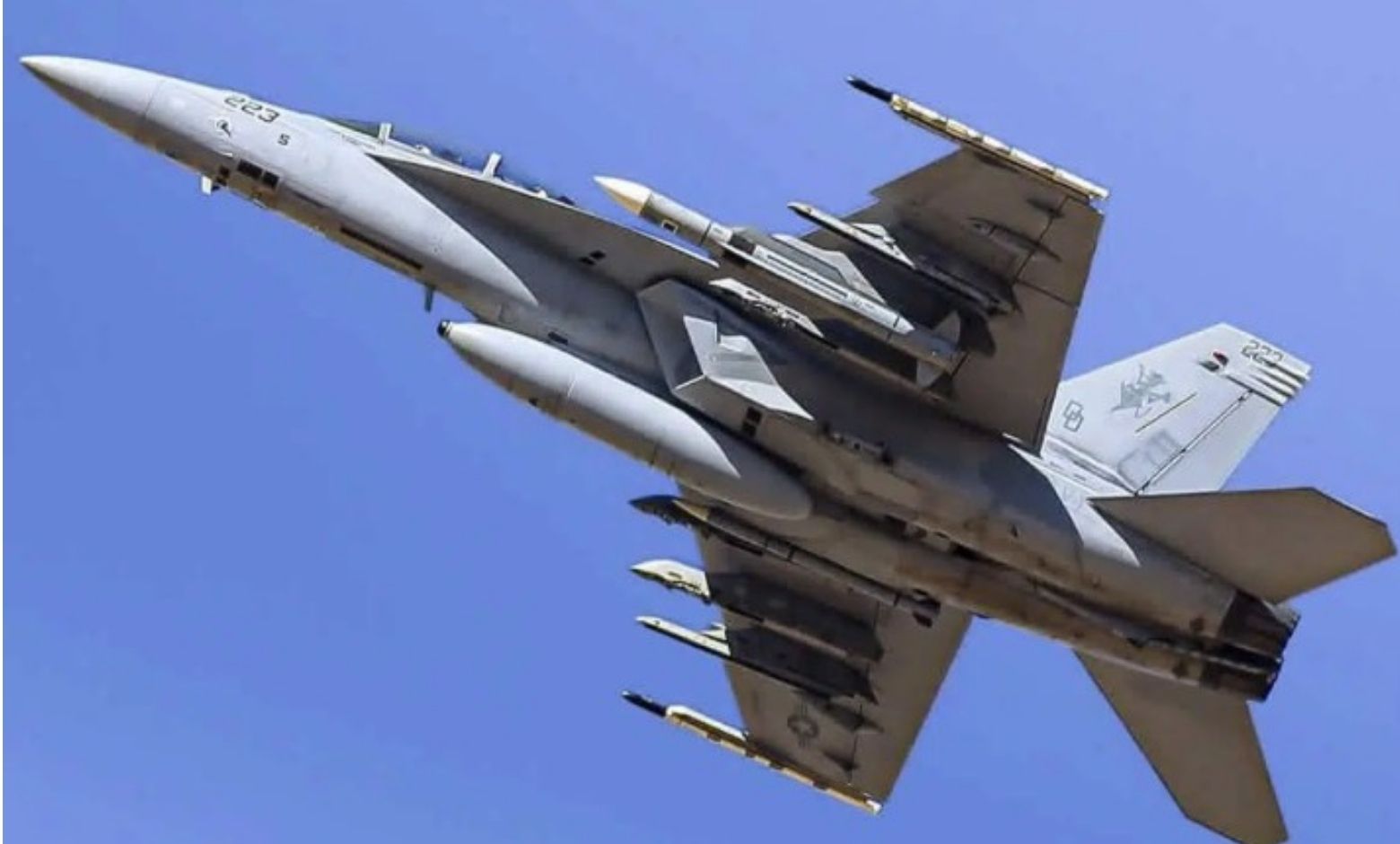
The U.S. Navy recently marked a significant development in aerial combat capabilities as an F/A-18F Super Hornet, assigned to Test and Evaluation Squadron VX-31, was observed simultaneously carrying two distinct air-to-air missile systems. This event, captured during a flight over Southern California, represents the first known instance of the Super Hornet integrating both the long-range AIM-174B and the next-generation AIM-260A Joint Advanced Tactical Missile (JATM) on a single platform. The aircraft was also equipped with Lockheed Martin’s advanced IRST21 Infrared Search and Track system, highlighting a comprehensive strategy to enhance sensor and weapon integration.
This pioneering missile integration is a critical initiative within the “Future Air Wing of the Carrier” (AWOTF) program. Slated for widespread implementation across naval carrier air wings within the coming decade, AWOTF aims to significantly expand the operational reach of current combat aircraft while seamlessly incorporating new sensor technologies, unmanned aerial systems, and advanced weapon platforms.
The Raytheon-developed AIM-174B is an air-launched variant of the formidable SM-6 missile system, traditionally used for surface-to-air engagements. Its considerably larger airframe enables an extended-range air-to-air engagement envelope, making it particularly effective against high-value aerial assets such as adversary airborne early warning (AEW) aircraft, strategic bombers, and other critical enemy air elements. The AIM-174B has already participated in major military exercises, including RIMPAC 2024 and Northern Edge 2025, and has begun deployment with U.S. Navy fleets stationed in Japan. Following extensive development trials conducted during RIMPAC, the missile is projected to enter its Live Fire Test and Evaluation phase in 2025.
Conversely, the Lockheed Martin-produced AIM-260A JATM is engineered to complement and eventually replace the widely deployed AIM-120 AMRAAM. Distinguished by its more compact dimensions and lighter weight compared to the AIM-174B, the JATM provides enhanced Beyond Visual Range (BVR) engagement performance. Its development focuses on delivering increased range and lethality against evolving advanced aerial threats. Ongoing flight testing for the JATM has seen VX-31 reportedly complete over 26 hours of flight tests in 2024. Information regarding these flight tests was briefly posted on a U.S. Navy Air Test and Evaluation Squadron social media channel before its subsequent removal, likely due to the sensitive nature of the operational data.
The concurrent integration of these two distinct air-to-air missile systems on the F/A-18F Super Hornet underscores a strategic leap for the U.S. Navy, promising enhanced flexibility, lethality, and adaptability for its carrier air wings in future contested airspace environments.


admin