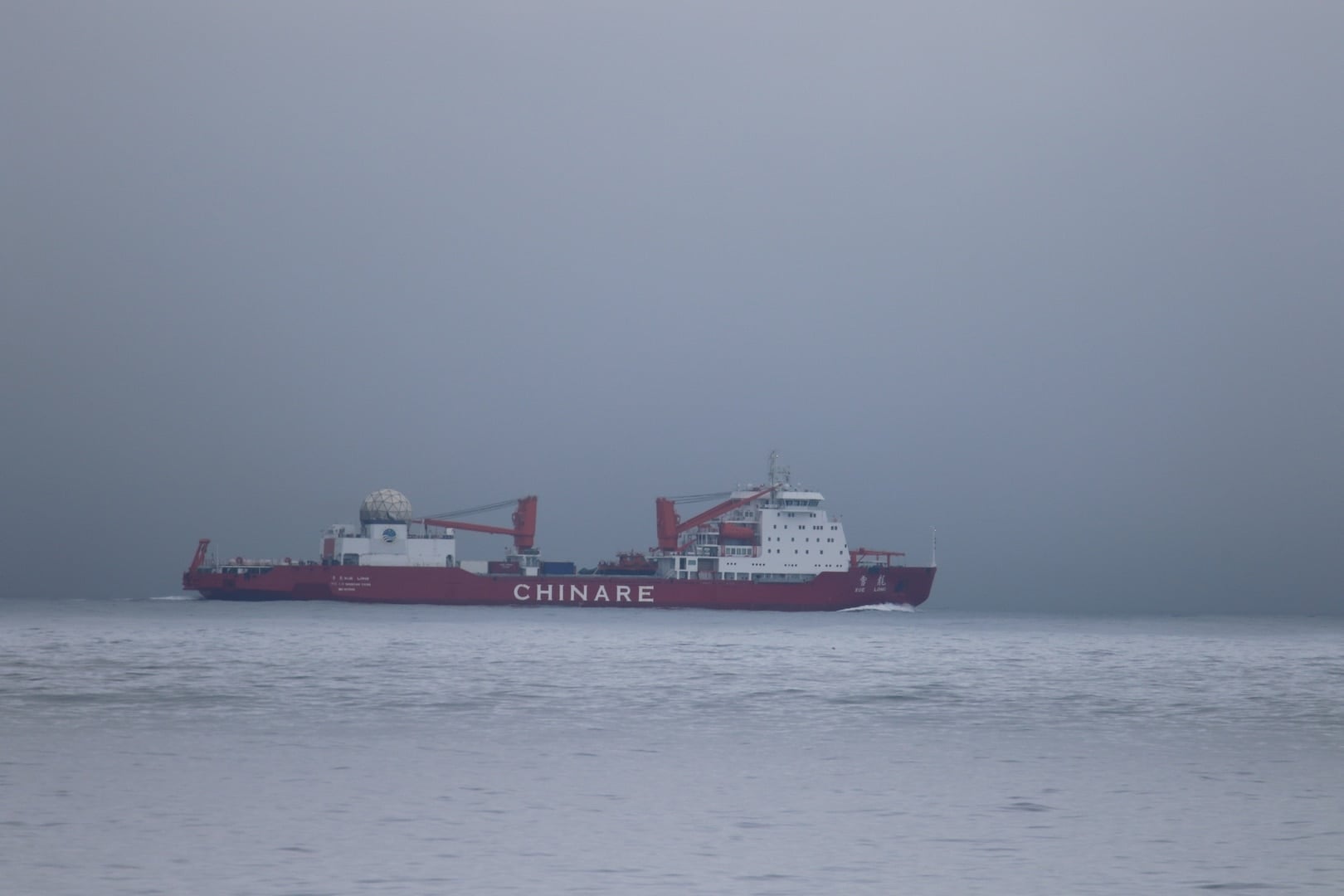
The United States Coast Guard (USCG) has confirmed the active monitoring of two People’s Republic of China (PRC) research vessels operating within American maritime jurisdiction off the coast of Alaska. This incident marks a notable departure from previous patterns, as the Chinese-flagged research icebreaker Xue Long and its escort, the Xue Long 2, reportedly traversed directly through the U.S. exclusive economic zone (EEZ) and extended continental shelf (ECS) in the Bering Sea, rather than merely transiting adjacent to these boundaries. This marks the first occasion this year that Chinese vessels have been tracked simultaneously within both these strategically vital regions, which separate Alaska from Russia’s far eastern coastline. Both vessels had previously declared their operational intent to be in the Arctic region.
Under international maritime law, an exclusive economic zone (EEZ) extends 200 nautical miles (approximately 370 kilometers) from a nation’s coastline, granting sovereign rights for the exploration, exploitation, conservation, and management of natural resources, including fishing and energy extraction. The waters themselves, however, remain open for international navigation. The extended continental shelf (ECS) further expands this jurisdiction, encompassing the seabed and subsoil of submarine areas that are a natural prolongation of the land territory beyond the 200-nautical-mile limit, thereby falling under American jurisdiction.
In response to this activity, the USCG deployed the USCGC Munro, a 127-meter Legend-class National Security Cutter homeported on the U.S. West Coast. This deployment was conducted under “Operation Frontier Sentinel,” a dedicated initiative designed to surveil competitor activities within and around U.S. Arctic waters and to facilitate rapid intervention should these activities escalate to pose a “genuine threat” to American sovereignty. Rear Admiral Bob Little, Commander of the USCG Arctic Region, characterized this response as an integral component of a wider, inter-agency coordinated effort.
Rear Admiral Little stated, “In conjunction with the U.S. Department of Defense, Department of State, and our international partners, we are actively addressing competitor activities in the increasingly strategic and contested Arctic region.”
While international maritime law generally permits foreign vessels to exercise freedom of navigation through a nation’s EEZ and ECS, the USCG emphasized that the legality of simple transit does not extend to unauthorized marine scientific research. Conducting any such research within these sensitive zones necessitates explicit prior authorization from the United States and carries a legal obligation to share all collected data with U.S. authorities.
This distinction holds significant weight, particularly as research vessels like the Xue Long and Xue Long 2 are equipped with advanced scientific instrumentation capable of comprehensive seabed mapping, hydrographic surveying, and data acquisition related to oceanographic conditions. Such data can serve dual purposes, supporting both legitimate civilian scientific endeavors and potentially informing military planning and intelligence gathering – a critical distinction that is often challenging to discern conclusively from the deck of a monitoring Coast Guard vessel.
Disclaimer: This content has been aggregated and reported by our automated systems.

admin