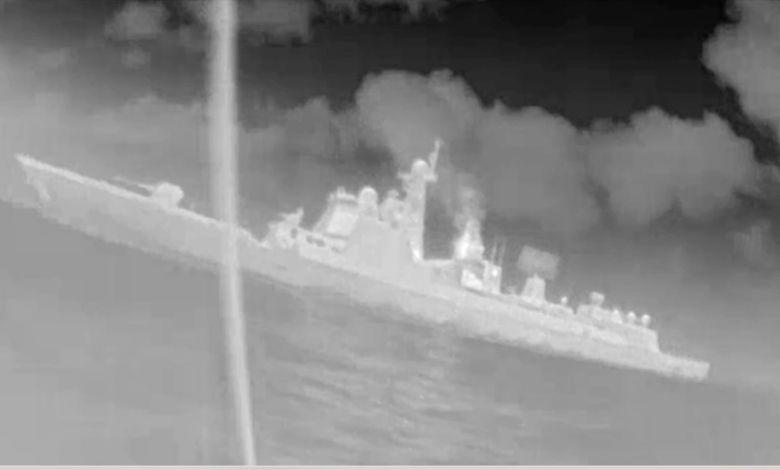
A Lightfish unmanned surface vessel (USV), developed by U.S.-based Seasats, successfully approached and gathered imagery of a Chinese People’s Liberation Army Navy (PLAN) Type 052D guided-missile destroyer operating off the coast of the Philippines. The incident, which took place on June 16 approximately 105 kilometers northwest of Luzon Island, has since been independently verified by Reuters.
This encounter highlights the burgeoning threat posed by low-cost, uncrewed maritime systems to high-value naval assets. The Lightfish, valued at approximately $240,000, managed to penetrate the defensive perimeter of a multi-billion dollar warship without detection, raising significant questions about naval surveillance capabilities against diminutive, stealth-optimized platforms.
Mike Flanigan, CEO of Seasats, confirmed that the Lightfish recorded visual data and other telemetry during its close proximity to the Chinese destroyer. He attributed the USV’s operational success to its compact size and exceptionally low-profile hull design, which allows it to frequently operate below conventional radar and sensor detection thresholds.
The Lightfish is an advanced maritime autonomous platform, propelled by a solar-electric system complemented by a hybrid backup power source. This configuration grants it an impressive operational endurance of up to six months and a range exceeding 8,000 nautical miles. Capable of carrying a modular payload of up to 30 kilograms, the USV can navigate at speeds up to 5 knots and maintain functionality in challenging Sea State 6 conditions, characterized by wave heights of up to six meters.
Designed for rapid deployment by a minimal crew of one or two personnel, the Lightfish incorporates sophisticated features such as autonomous collision avoidance, navigation in GPS-denied environments, and secure satellite communication. Its modular architecture allows for the integration of a diverse range of mission-specific systems, including high-resolution electro-optical and thermal cameras, navigation radar, active and passive sonar arrays, and specialized signal intelligence (SIGINT) and electronic warfare (EW) payloads.
The Type 052D destroyer, also known as the Luyang III-class, is a formidable surface combatant in the PLAN inventory. These vessels displace approximately 7,500 tons at full load, carry a crew of around 280, and can achieve maximum speeds of 30 knots. Their offensive and defensive capabilities are substantial, featuring a 64-cell vertical launch system (VLS)—32 cells forward and 32 aft—capable of deploying HHQ-9 long-range surface-to-air missiles, YJ-18 anti-ship missiles, and CY-5 anti-submarine warfare (ASW) missiles. Additional armaments include a 130mm main gun, Type 730 or Type 1130 close-in weapon systems (CIWS), a 24-cell HHQ-10 short-range air defense missile launcher, and an onboard helicopter hangar.
Seasats has disclosed that Lightfish USVs have previously encountered various PLAN warships, including other Type 052 and Type 055 class destroyers, as well as Type 056 corvettes. Notably, in May 2026, a Lightfish became the first USV to autonomously traverse the Taiwan Strait. During this five-day mission, it covered over 1,000 nautical miles, actively monitoring and capturing imagery of maritime traffic, including a PLAN Type 056 corvette operating within the sensitive waterway.


admin