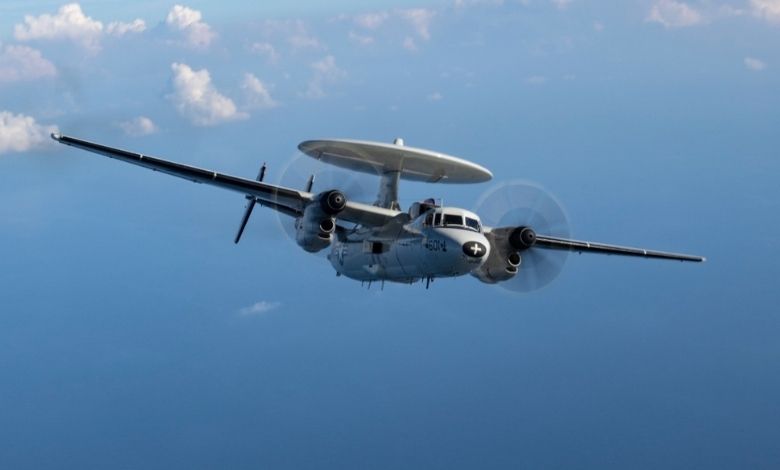
The United States Navy has finalized a significant contract with Northrop Grumman for the procurement of three E-2D Advanced Hawkeye Block II Airborne Early Warning and Control (AEW&C) aircraft. Announced by the Department of Defense on July 22, the contract, valued at up to $1.196 billion, encompasses the full production, delivery, and associated support services for these critical platforms. A substantial allocation of $583.394 million from the Fiscal Year 2026 US Navy aircraft procurement budget has already been committed to this order, with deliveries anticipated to conclude by December 2031.
This new acquisition is strategically vital for sustaining the E-2D’s final assembly line operations for the foreseeable future. Northrop Grumman currently holds a backlog of approximately 28 E-2D orders pending delivery. However, the long-term viability of the production facility hinges on securing additional domestic or international sales. In the absence of new export customers or further US orders, the US government has reportedly initiated contingency planning for a potential cessation of the production line.
The E-2D Advanced Hawkeye Block II represents the latest evolution in the venerable E-2 AEW&C family, which boasts over six decades of operational service. Northrop Grumman asserts that the Block II modernization introduces enhanced capabilities, alongside improvements in mission readiness rates and overall system reliability. Jointly, Northrop Grumman and Lockheed Martin concluded flight testing for the E-2D’s Digital Receiver, Exciter, and Recorder System modernization in April 2026. Concurrent efforts are also underway to upgrade existing E-2D aircraft in the fleet, incorporating features such as an aerial refueling probe, comprehensive fuel system modifications, cockpit redesigns, and updated avionics components.
Developed as a successor to the E-2C Hawkeye, the E-2D Advanced Hawkeye first took to the skies on August 3, 2007. The initial aircraft was delivered to the US Navy on July 29, 2010, primarily for personnel training, and achieved Initial Operational Capability (IOC) in October 2014.
Operational from aircraft carriers, the E-2D performs a diverse array of missions, including airborne early warning and surveillance, command and control, battle management, and the coordination of air and missile defense operations. Its robust capabilities extend to vectoring friendly fighter aircraft, tracking both maritime and land-based targets, and orchestrating search and rescue missions. The aircraft’s AN/APY-9 radar provides 360-degree coverage across open ocean, littoral, and overland environments, specifically engineered for the detection and tracking of airborne platforms and low-altitude cruise missiles. Data from detected targets is seamlessly shared with other naval and joint assets, including fighter jets and warships.
Measuring approximately 17.6 meters in length and featuring a 24.6-meter wingspan, the E-2D has an empty weight of around 18.3 tons. It can achieve speeds exceeding 555 kilometers per hour and operate at altitudes of up to 11,300 meters. A key enhancement in newly produced E-2D aircraft is the integrated aerial refueling capability, which significantly extends the aircraft’s mission endurance and operational reach far beyond the immediate vicinity of its carrier.
Beyond US service, the E-2D Advanced Hawkeye has garnered international interest. Japan, its inaugural foreign customer, initially ordered 13 units and subsequently committed to acquiring an additional five, bringing their total planned fleet to 18 aircraft. France has also placed an order for three E-2Ds, which are slated to replace the French Navy’s existing E-2C Hawkeyes beginning in 2028. While Egypt and Taiwan operate earlier variants of the E-2 family, their current inventories do not include the E-2D model.


admin