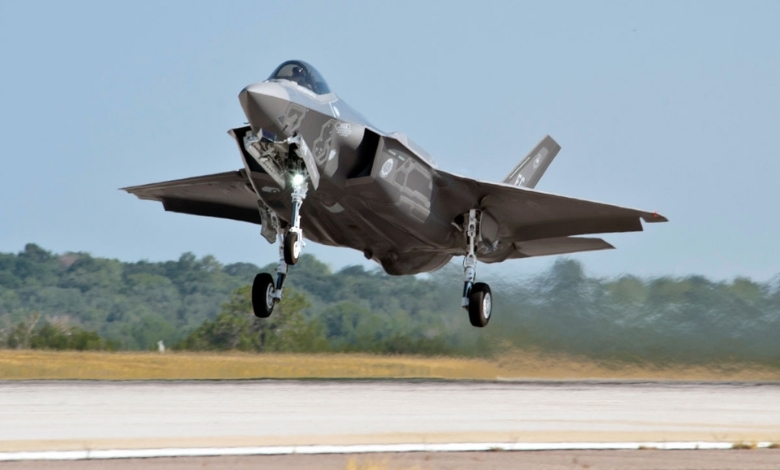
Lockheed Martin, the U.S. defense prime contractor, has been awarded a new $100 million contract aimed at alleviating persistent thermal management challenges impacting its F-35 Lightning II fighter aircraft fleet. Issued by the U.S. Naval Air Systems Command (NAVAIR), the agreement stipulates the production of 1,459 critical brake system heat sink components. Specifically, 1,075 units are designated for the F-35A conventional takeoff and landing variant, with an additional 384 units for the F-35B short takeoff and vertical landing variant. This initiative is projected to run until 2030.
Experts highlight that the significant thermal loads generated by the F-35 platform, particularly under high operational tempo, extend beyond just the braking system, impacting the sophisticated avionics infrastructure as well. Weighing over 13 metric tons when fully loaded, F-35s must rapidly dissipate immense kinetic energy over confined runway distances during high-speed landings. The intense heat generated during this process can exert considerable stress on vital wiring, sensors, and avionics connections, potentially compromising system integrity. The newly contracted heat sink components are engineered to absorb this generated heat during landings, effectively preventing its transfer to adjacent critical systems.
A persistent challenge within the F-35 program has been the adequacy of its depot-level maintenance capacity. Previous reports from the U.S. Government Accountability Office (GAO) have consistently underscored that the F-35 fleet’s mission readiness rates frequently fall below target thresholds, largely attributed to deficiencies in its maintenance infrastructure. Shortages, particularly in brake system components, are understood to significantly delay aircraft return to operational squadrons, exacerbate maintenance backlogs, and directly impede overall mission readiness.
Currently, 19 nations, including the United States, United Kingdom, Japan, Australia, South Korea, Norway, Netherlands, Italy, and Denmark, operate the F-35. The global fleet now comprises over 1,100 aircraft.
Industry experts suggest that the current brake system issue represents only a segment of the F-35’s broader thermal management challenges. Anticipated enhancements under the Block 4 modernization package, such as advanced radars, electronic warfare systems, and more powerful mission computers, are expected to push the limits of the platform’s current cooling architecture. In response, Collins Aerospace and Honeywell Aerospace are actively developing next-generation power and thermal management systems. However, this more comprehensive upgrade is not expected to be fully operational before the 2030-2032 timeframe.
Consequently, the immediate procurement of these heat sink components is viewed as a critical interim measure designed to alleviate urgent sustainability concerns across the F-35 fleet, pending the completion of its long-term modernization program.
Disclaimer: This content has been aggregated and reported by our automated systems.


admin