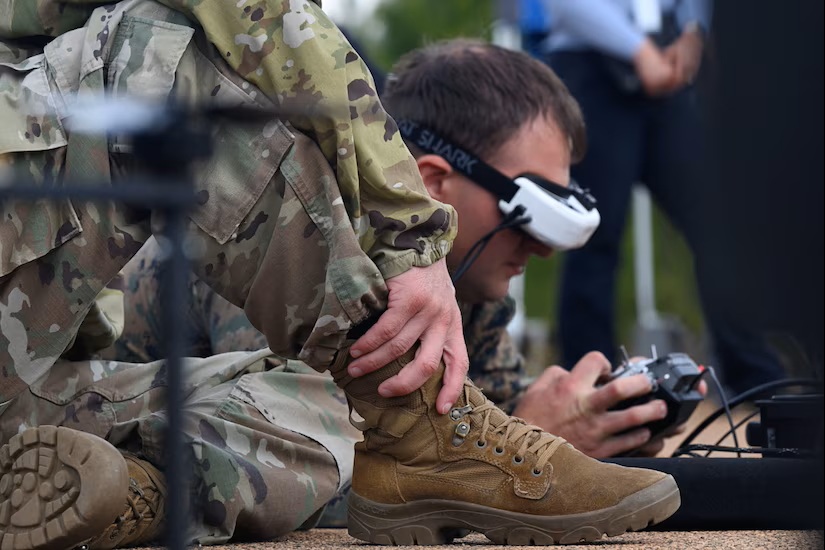
The War Department’s ambitious Drone Dominance Program recently concluded its Gauntlet Phase II qualification rounds at Camp Grayling, Michigan, showcasing a pivotal moment in accelerating advanced unmanned aerial systems (UAS) into frontline service. This rigorous assessment involved 49 defense companies deploying 79 distinct UAS platforms in demanding mission profiles, encompassing long-range precision strikes and close-quarters tactical engagements. Each participant supplied 20 unmanned assets, underscoring the intensity of the competition designed to address the rapidly evolving nature of modern warfare.
This comprehensive, two-year initiative, backed by a robust $1.1 billion investment, directly implements President Donald J. Trump’s Executive Order 14307. The directive underscored the imperative for the War Department to swiftly procure, integrate, and operationalize cost-effective, high-performance drones manufactured domestically. The overarching objective is to rapidly furnish combat units with a formidable, scalable fleet of low-cost, expendable one-way attack drones. Beyond enhancing military readiness, the program aims to stimulate private capital investment into the U.S. defense industrial base, simultaneously driving down unit costs for these critical assets.
Under the joint stewardship of the Defense Innovation Unit (DIU) and the Test Resource Management Center (TRMC), and sponsored by the Office of the Secretary of War, the Drone Dominance Program epitomizes a fundamental shift towards a challenge-based acquisition methodology. This new paradigm forsakes protracted, multi-year procurement cycles in favor of agile, six-month developmental sprints. The program structure involves four “gauntlet” phases, each presenting increasingly complex and realistic challenges designed to identify and validate the most resilient and effective UAS platforms. Successful technologies from each phase are then fast-tracked for large-scale production, ensuring warfighters gain a decisive tactical advantage.
Owen West, Director of the DIU, emphasized the critical urgency of the program. “Our adversaries are scaling their UAS technology, tactics, and industrial capabilities at an alarming rate,” West stated. “Following Secretary of War [Pete] Hegseth’s directives, we are acting decisively to develop new defensive and offensive capabilities to counter these evolving threats.” West further highlighted tangible progress, noting the acceptance of the initial batch of drones, with nearly 2,000 additional units already shipped to service branches and thousands more in advanced stages of fulfillment.
Building on a highly successful Phase I, which saw the procurement of 30,000 drones, the department is preparing for its next major milestone. Travis Metz, DIU Deputy Director, affirmed, “As mandated by President Trump and Secretary Hegseth, we have commenced equipping our warfighters with the world’s most capable drones. We have successfully ordered 30,000 units, currently undergoing delivery, and anticipate ordering an additional 60,000 units in September. These acquisitions are directly informed by competitive performance events and our ongoing efforts to onshore supply chains within the United States.”
By strategically leveraging fierce commercial competition, amplified by public performance leaderboards, the War Department aims to dramatically scale drone production from 30,000 to 150,000 units per phase. Concurrently, the program targets a substantial reduction in unit cost, from an initial $5,000 to approximately $3,000. The ambitious long-term vision for the Drone Dominance Program is to field over 200,000 lethal, artificial intelligence-enabled drones by 2027, thereby securing a definitive technological leap for the U.S. military and an enduring asymmetric advantage over potential adversaries. The eagerly anticipated Gauntlet II competition is scheduled to commence later this summer. This next phase will escalate the challenge significantly, requiring entrants to deploy 120 drones per company and expanding operational scenarios to include complex night operations, as well as engagements within demanding urban and confined environments.
Disclaimer: This content has been aggregated and reported by our automated systems.


admin