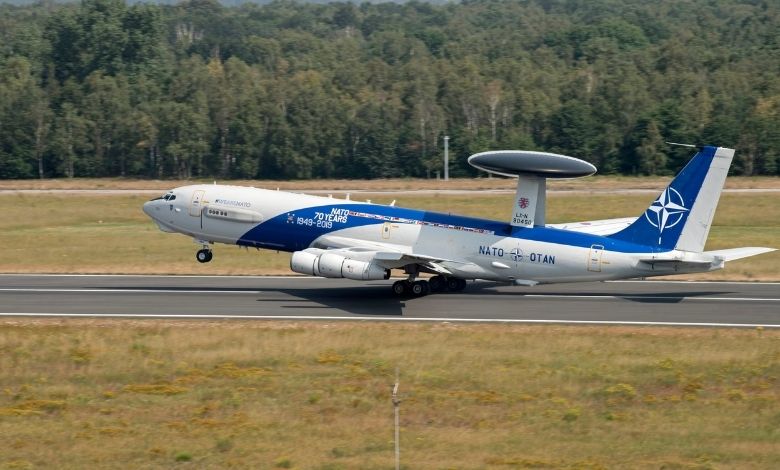
NATO is reportedly preparing to phase out its venerable E-3A Airborne Warning and Control System (AWACS) fleet, a cornerstone of the alliance’s airborne early warning capabilities for nearly half a century. According to Reuters, citing four independent sources, the alliance has chosen the Saab GlobalEye as its next-generation airborne early warning and control (AEW&C) and surveillance platform. This significant decision is anticipated to be formally announced during the upcoming NATO Summit, scheduled for July 7-8 in Ankara.
Since 1982, the 14 E-3A AWACS aircraft, stationed at Germany’s Geilenkirchen Air Base, have provided critical airborne early warning, comprehensive airspace surveillance, command-and-control (C2), and air operation management for the alliance. Their operational tempo significantly intensified on NATO’s eastern flank following the commencement of the Russia-Ukraine conflict, underscoring their irreplaceable role in alliance security. Future plans reportedly envision Geilenkirchen transitioning to host the world’s largest GlobalEye fleet.
This procurement marks a pivotal shift after a previous attempt in 2023 when NATO had opted to acquire six Boeing E-7 Wedgetail aircraft to replace the AWACS. However, this plan was shelved in 2025 following the Pentagon’s decision to cancel its own E-7 program in favor of satellite-based solutions. Despite this, recent reports indicated efforts to re-evaluate the E-7 program within the U.S. budget.
NATO is not alone in its pivot towards the GlobalEye system. In May 2026, the Canadian government similarly announced its intention to acquire the Saab GlobalEye platform, choosing it over the Boeing E-7 Wedgetail and opting for a non-U.S. solution.
The Saab GlobalEye represents a significant leap in AEW&C technology. Developed on a Bombardier Global 6500 business jet platform, it integrates the advanced Erieye ER Active Electronically Scanned Array (AESA) radar, enabling simultaneous detection and tracking of air, land, and sea targets. The system boasts an approximate 600-kilometer detection range for air targets and is capable of long-range maritime surveillance. Enhanced by electronic support measures (ESM), electro-optical (EO) sensors, and a dedicated maritime surveillance radar, GlobalEye delivers multi-domain reconnaissance, intelligence, surveillance, and target acquisition (ISR) capabilities from a single platform. It offers an impressive endurance of approximately 11 hours, facilitating extended high-altitude missions.
In contrast, the legacy Boeing E-3A AWACS, based on the Boeing 707 airframe, featured a distinctive rotating radar dome providing 360-degree aerial surveillance. While revolutionary in its time for commanding and controlling air operations and coordinating the battlespace, the GlobalEye’s multi-domain, static-array radar technology represents a modernization essential for contemporary threats.
Disclaimer: This content has been aggregated and reported by our automated systems.


admin