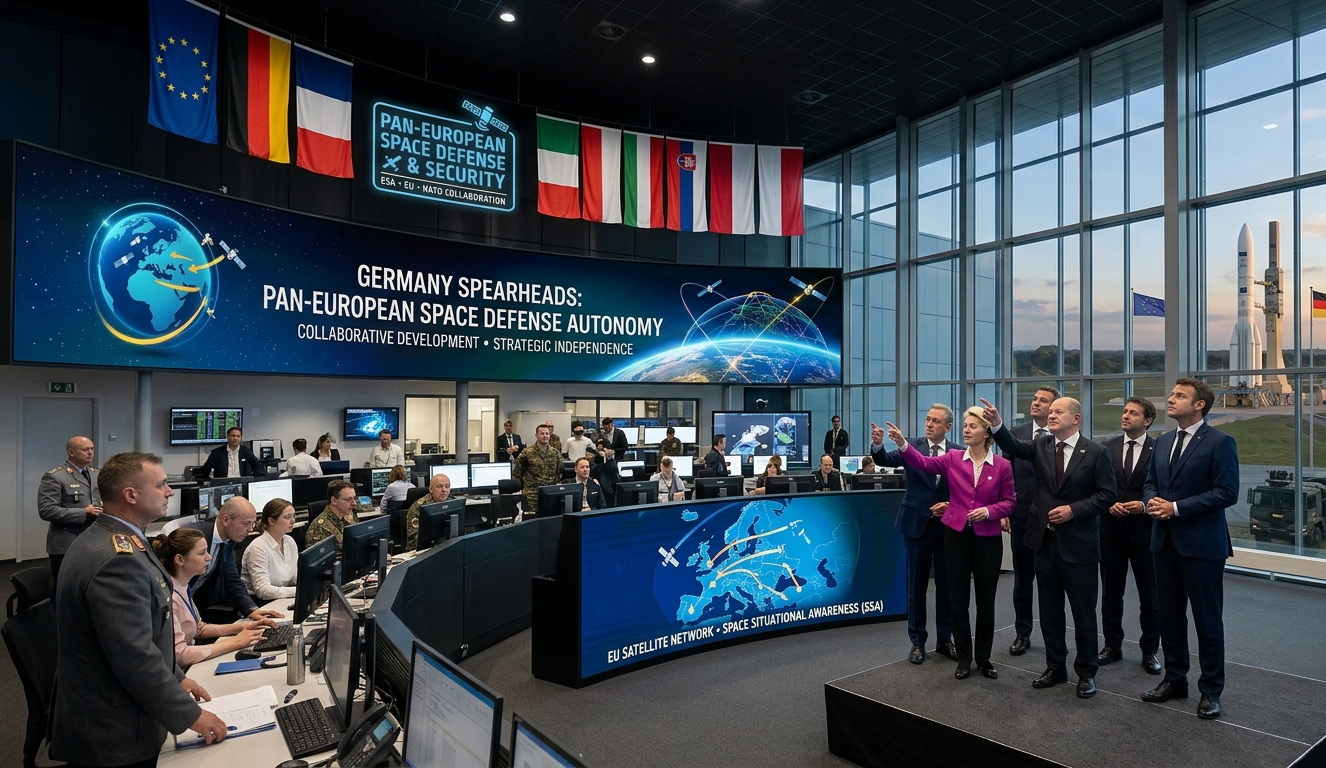
VIENNA — Germany’s Defense Minister, Boris Pistorius, recently leveraged a strategic quadrilateral assembly of German-speaking defense chiefs to advance the concept of a unified European military space command. He urged key allies, including Austria, Switzerland, and Luxembourg, to actively co-develop the framework rather than merely subscribing to pre-established architectures.
Speaking at a press conference in Berlin, Pistorius outlined Germany’s commitment to developing a “European Space Component Command” alongside a “Weltraumakademie,” a nascent multilateral space training academy. He stressed the importance of embedding partner nations in the foundational design stages, ensuring their involvement from inception. This gathering, uniquely dubbed the “DACH+L” format—expanding the traditional German-Austrian-Swiss defense dialogue to include Luxembourg—served as a crucial platform for Pistorius to underscore traction on Germany’s substantial €35 billion military space investment, initially pledged last fall. This extensive program encompasses resilient low-Earth-orbit (LEO) satellite constellations, sovereign military-grade launch capabilities, and an enhanced Space Command embedded within the Bundeswehr.
Austria’s Defense Minister, Claudia Tanner, confirmed plans for next year’s launch of three operationally designated military satellites and an additional test object, partially developed in collaboration with Austrian startups. The program features two primary projects: LEO2VLEO, a joint initiative with the Netherlands focusing on imaging and navigation in very low Earth orbit (VLEO), and BEACONSAT, an Austrian navigation satellite developed for under €1 million. Tanner emphasized the collaborative utility of these assets for partners, framing the endeavor as pivotal for ensuring communications autonomy in crisis scenarios. While constitutionally neutral, Austria’s deepening defense ties with European partners are increasingly triggering a re-evaluation of its traditional stance.
Luxembourg’s Defense Minister, Yuriko Backes, making her debut at a DACH meeting, highlighted her nation’s specialized expertise in satellite communications (SATcom) and Earth observation, affirming Luxembourg’s readiness to share these capabilities with allies and partners. Both Backes and Tanner alluded to a forthcoming bilateral agreement on satellite utilization between their countries scheduled for July, without providing further specifics.
Swiss Federal Councilor Martin Pfister underscored Europe’s critical dependence on non-European technology suppliers in the space domain, asserting that no single nation possesses the capacity to resolve this challenge autonomously. He specifically mentioned the Swiss state-owned firm Beyond Gravity as a potential industrial contributor to a collective European solution. Switzerland, much like Austria, has increasingly aligned with broader European defense projects, notably joining the German-led European Sky Shield Initiative (ESSI) in 2023, reflecting a nuanced shift in its neutrality posture following the conflict in Ukraine.
The DACH+L meeting itself, signifying an expansion of the established DACH format, visibly underscored the deepening Central European defense cooperation. While concrete deliverables were modest—a reaffirmation of existing cooperative threads, a commendable second-place finish by Luxembourg (alongside the other German-speaking nations) at NATO’s Locked Shields cyber exercise under German leadership in April, and burgeoning political momentum for largely conceptual space initiatives—the overarching strategic message was unequivocal: German-speaking Europe is resolute in its ambition to become a formidable actor in the space sector, dedicated to diminishing its technological reliance on external powers, particularly the United States.
Disclaimer: This content has been aggregated and reported by our automated systems.

admin