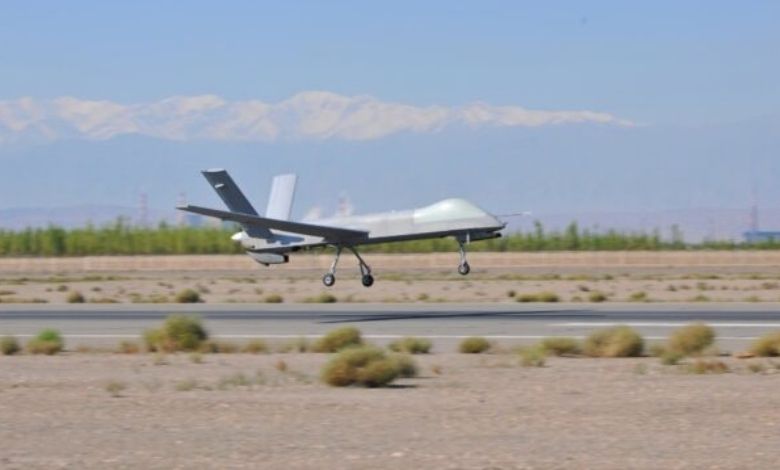
Armenia’s previously clandestine acquisition of Chinese-made CH-4 Rainbow armed uncrewed combat aerial vehicles (UCAVs) has been publicly confirmed, with the platforms observed during preparations for a military parade commemorating Republic Day on May 28th. Visual evidence emanating from Yerevan decisively substantiates earlier, unverified reports concerning the deployment of CH-4 platforms at Gyumri Air Base. Despite this public display, neither the Armenian government nor its Ministry of Defense has issued any official statement regarding the procurement program.
Open-source intelligence analyses suggest the CH-4 platforms were likely delivered covertly between 2024 and 2025, with a minimum of two units currently assessed as operationally active. A notable observation was the presence of six 40-foot ISO containers adjacent to the platforms. Analysts interpret this robust logistical footprint as indicative not merely of platform delivery, but rather of a comprehensive Medium Altitude Long Endurance (MALE) UCAV operational ecosystem, encompassing critical maintenance infrastructure, ground control stations, and essential support elements. The strategic positioning of the CH-4s at Gyumri Air Base, in close proximity to Russia’s 102nd Military Base – one of Moscow’s most significant military assets in Armenia – adds a compelling geopolitical dimension to this development.
Developed by China Aerospace Science and Technology Corporation (CASC), the CH-4 is engineered for multi-mission capabilities, including intelligence, surveillance, and reconnaissance (ISR), target designation, and precision strike operations. Bearing a design resemblance to the US-manufactured MQ-9 Reaper UCAV, the platform boasts an impressive endurance of approximately 30 hours and features long-range satellite-based control capabilities. Its sensor suite includes advanced night vision, thermal imaging, and electro-optical camera systems. For offensive operations, the CH-4 can be armed with AR-1 anti-tank guided missiles, laser-guided bombs, and various other precision-guided munitions. This system is optimally suited for deep ISR missions, real-time target coordinate relay, artillery fire correction, and precise engagements against armored targets.
While China has extensively exported the CH-4 platform to various nations in the Middle East and Africa in recent years, with the system actively deployed in numerous conflict zones, its appearance in Armenia marks a significant shift in regional military capabilities. Military analysts largely interpret the emergence of the CH-4 platforms as a critical component of Armenia’s strategic re-evaluation and reshaping of its defense doctrine in the aftermath of the 2020 Nagorno-Karabakh War.
During the Second Nagorno-Karabakh War in 2020, Azerbaijani forces employed Turkish-supplied Bayraktar TB2 UCAVs alongside Israeli-made loitering munitions such as the Harop, Orbiter, and SkyStriker with devastating effect. The systematic targeting of Armenian air defense systems, main battle tanks, artillery units, and logistical convoys by uncrewed aerial systems (UAS) became a seminal case study illustrating the transformative impact of UCAV/UAS integration in modern warfare. Public dissemination of precision strike footage, particularly from the Bayraktar TB2 platforms, garnered global attention, leading many international observers to label the conflict a “drone war.” Having sustained substantial losses during this conflict, Armenia is now perceived to be actively re-aligning its air defense architecture, enhancing its intelligence, surveillance, and reconnaissance capabilities, and fundamentally restructuring its uncrewed systems doctrine in the post-war period. Military strategists suggest that the covert CH-4 deployment transcends mere platform acquisition. It signifies a profound commitment to achieving operational readiness, integrating advanced uncrewed systems into existing military doctrine, and adapting to evolving battlefield concepts characterized by sophisticated UAS capabilities.
Disclaimer: This content has been aggregated and reported by our automated systems.

admin