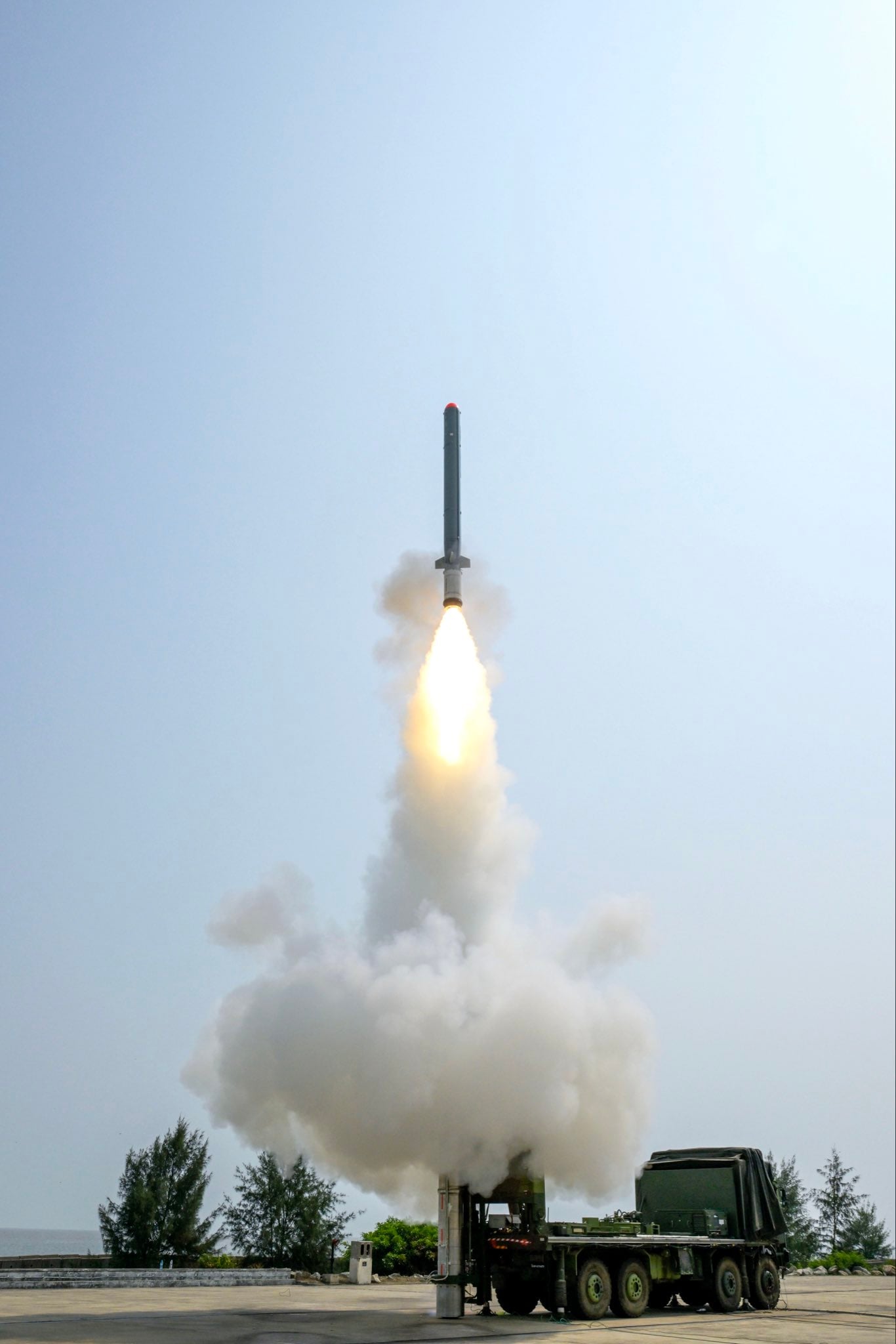
India’s defense capabilities have taken a significant step forward with the successful flight test of a domestically developed Long Range Land Attack Cruise Missile (LRLACM). The Defence Research and Development Organisation (DRDO) officially announced on June 15, 2026, that the missile was launched from Dr. APJ Abdul Kalam Island, situated off the coast of Odisha.
According to data gathered from various tracking systems deployed by the Integrated Test Range (ITR) at Chandipur, the test launch successfully met all predetermined objectives. This strategic test was closely monitored by senior DRDO officials, as well as representatives from the Indian Navy and Indian Air Force, both of whom are anticipated to integrate the missile into their future operational inventories.
Defence Minister Rajnath Singh extended his commendations to the DRDO team and industry partners involved in the project following the successful launch. Similarly, Dr. Rajesh Kumar Singh, Secretary of Defence R&D and Chairman of DRDO, who personally observed the test activities, congratulated all personnel contributing to the successful flight.
The LRLACM project underscores India’s commitment to indigenous defense manufacturing. Its design and development process, including all major subsystems, have been executed entirely within India, involving collaborative efforts between various DRDO laboratories and several Indian defense industry stakeholders. The Bengaluru-based Aeronautical Development Establishment (ADE) is leading the charge as the primary executor of this ambitious initiative.
Designed for high-precision strikes against land targets over extended ranges, the LRLACM operates at subsonic speeds. It features a sophisticated propulsion system, utilizing either a turbofan or turbojet engine. Its advanced guidance suite combines an inertial navigation system (INS) augmented by satellite navigation for accurate mid-course correction, and incorporates options for a seeker head or terrain contour matching (TERCOM) for precise terminal phase engagement.
Crucially, the LRLACM is engineered for a low-altitude, terrain-hugging flight profile, significantly reducing its detectability and vulnerability to interception. It is designed to deliver a conventional warhead against high-value targets. India’s indigenous program also focuses on modular subsystem architecture, aiming for enhanced operational flexibility, potential export capabilities within policy frameworks, and compatibility across diverse launcher platforms.
Disclaimer: This content has been aggregated and reported by our automated systems.


admin