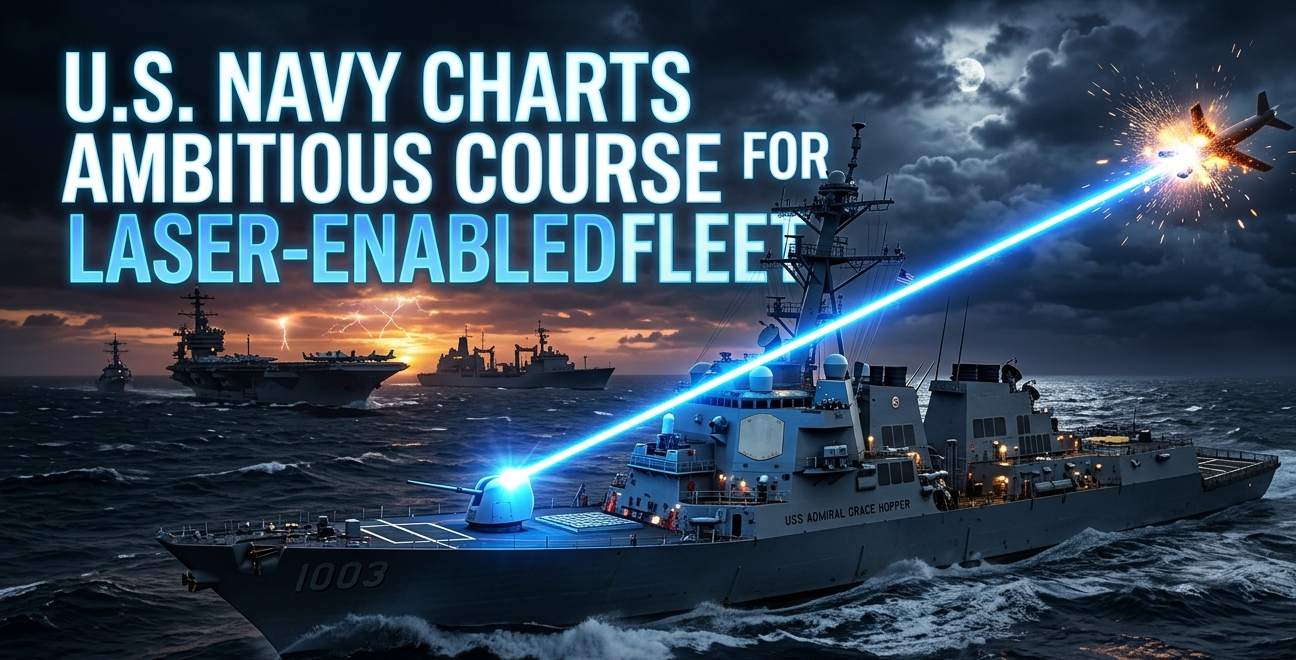
While Operation Epic Fury vividly illustrated the imperative for advanced defensive capabilities, the U.S. Navy’s vision of integrating directed energy weapons across its surface fleet faces significant hurdles, primarily concerning power generation and platform integration. Chief of Naval Operations (CNO) Admiral Daryl Caudle, a staunch advocate for directed energy, recently presented a compelling case to the House Armed Services Committee on May 14th, underscoring the critical need for high-energy laser systems.
Admiral Caudle articulated that high-energy lasers are indispensable for future naval warfare, particularly for ballistic missile and terminal defense. He emphasized that current operational doctrine, which mandates a trade-off between defensive interceptors and offensive strike weapons within the finite capacity of Vertical Launching Systems (VLS) on vessels like the Arleigh Burke-class destroyers—dubbed the “workhorses of the surface Fleet”—is unsustainable. “Every VLS cell utilized for a defensive missile represents a forfeited opportunity for a long-range offensive strike,” Caudle stated, advocating for lasers to free these cells for maximizing offensive punch.
However, Caudle’s testimony also acknowledged that the realization of a truly laser-centric fleet remains a distant prospect. This ambitious transformation hinges on the development of future surface combatants, such as proposed nuclear-powered battleships, which must be engineered from the keel up with the substantial power and cooling infrastructure necessary to scale directed energy systems to megawatt-class levels. These advanced platforms are crucial for delivering decisive lethality against sophisticated threats.
Translating these designs into operational reality demands focused investment in research and development. Caudle called for prioritizing compact, high-density energy storage and advanced thermal management systems to meet the rigorous demands of directed energy weapons. Additionally, significant funding is required for digital engineering and land-based test facilities to de-risk the complex integration of these advanced systems with existing combat and ship control architectures. The current surface fleet, including the most modern Flight III Burke-class destroyers, simply cannot support the immense power requirements of high-energy lasers at scale, with their generators already fully committed to systems like the AN/SPY-6 Air and Missile Defense Radar.
The urgency of this paradigm shift was starkly illustrated by events during Operation Epic Fury. The Presidential Unit Citation awarded to the USS Gerald R. Ford Carrier Strike Group detailed how nine surface combatants expended 207 Tomahawk Land Attack Missiles at Iranian targets over a two-month period. Assuming these were Arleigh Burke destroyers, with an aggregate VLS capacity of approximately 864 cells, this meant only about one offensive weapon was fired for every four available cells. The remaining capacity was predominantly allocated to defensive interceptors, which were vital for protecting the strike group from persistent missile and drone threats, underscoring Caudle’s “unsustainable paradigm.” Moreover, unlike fuel or provisions, vertical launch munitions cannot be reliably replenished at sea under operational conditions, despite ongoing efforts like the Transferrable Reload At-Sea Method (TRAM) program.
The theoretical elegance of directed energy as a solution is undeniable: a laser weapon capable of defending a warship for roughly $10 per shot would liberate VLS cells for a full complement of offensive Tomahawks and high-end SM-6s, transforming destroyers into platforms optimized for offensive power projection.
To bridge the gap between current fleet capabilities and future integrated laser warships, CNO Caudle highlighted the Containerized Capability Campaign (C³). This initiative aims to enable the modular deployment of various payloads, including missiles, unmanned systems, sensors, electronic warfare packages, and directed energy, across a broad array of platforms and shore sites without requiring major structural redesigns. Caudle posits that containerization decouples payloads from platforms, accelerating capability adaptation beyond traditional acquisition timelines and delivering combat power “at the speed of relevance.”
This strategy is already yielding results. In October 2025, the Navy successfully conducted a live-fire test of the palletized 30 kW LOCUST Laser Weapon System from the flight deck of the Nimitz-class aircraft carrier USS George H.W. Bush, demonstrating the feasibility of drawing significant power from a carrier’s nuclear reactors. Lockheed Martin is also developing a containerized version of the 60 kW High Energy Laser with Integrated Optical Dazzler and Surveillance (HELIOS) system, currently aboard USS Preble, to ensure its seamless transferability between vessels undergoing maintenance. The Navy’s Fiscal Year 2027 budget request further supports the marinization and integration of the U.S. Army’s Enduring High Energy Laser (E-HEL) systems for potential shipboard applications.
A more significant containerized endeavor is the Joint Laser Weapon System (JLWS), an Army-Navy collaboration designed from its inception as a modular system. The JLWS, with an initial target of 150 kW and scalability to at least 300 kW for cruise missile defense, will also feature a Joint Beam Control System (JBCS) capable of supporting weapons up to 500 kW. A combined R&D investment of $675.93 million is planned through FY2031, with initial JBCS development contracts anticipated by late 2026. If successful, JLWS could deliver a containerized laser powerful enough to address the missile threats at the core of Caudle’s VLS argument, significantly ahead of integrated next-generation warships.
In essence, Caudle’s testimony outlines two parallel directed energy development pathways, with a third, bridging approach emerging between them. One path focuses on near-term, lower-power containerized systems like LOCUST and HELIOS, deployable on current platforms and effective against the burgeoning drone threat. The other is a transformational, long-term vision of megawatt-class systems deeply integrated into future battleships, not expected to join the fleet for nearly a decade. The JLWS represents an attempt to bridge this gap, offering a robust containerized missile defense capability that could materialize well before the dedicated laser-equipped battleships. Operation Epic Fury has undoubtedly reinforced the strategic imperative for a laser fleet that aligns with the Navy’s ambitious operational requirements; whether they can construct it within the desired timelines remains the ultimate challenge.
Disclaimer: This content has been aggregated and reported by our automated systems.


admin